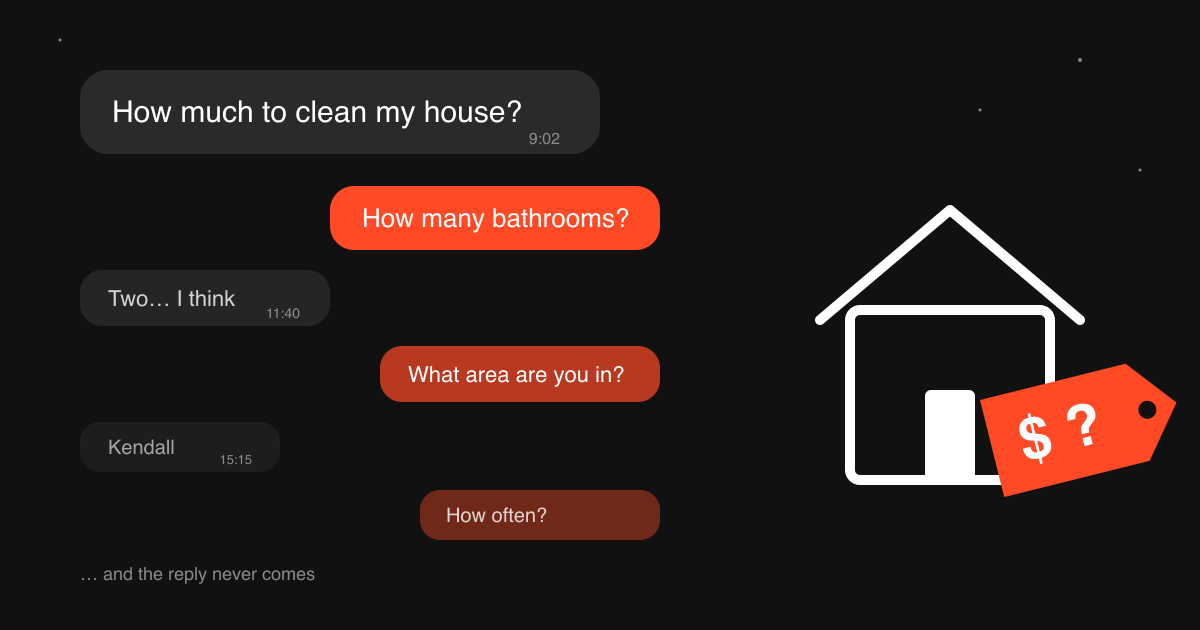
A message comes in: “Hi, how much to clean my house?”
And the only honest answer is: it depends.
On how big it is. Where it is. Whether it’s a one-time thing or every week. Whether anyone’s deep cleaned it in months.
So instead of a price, you reply with a question. Then another. And another.
Sound familiar?
If you’re here to figure out what to charge, I’ll walk you through it. But here’s the thing: you rarely lose a client because your price is too high. You lose them because of how long it takes you to give it.
How much to charge to clean a house: what it depends on
The price of a house cleaning mostly comes down to six things: size, type of place, area, how often, whether it’s the first clean, and extras.
Size. Square footage, and above all, how many bedrooms and bathrooms. A bathroom is more work than a bedroom.
House or business. An office or a store is priced differently: after-hours schedules, a different kind of mess, and sometimes a fixed contract.
Area. A house ten minutes away isn’t the same as one forty minutes away. Driving is time too.
How often. A house you clean every week never gets that dirty. One you clean once a month does. That’s why frequent cleanings usually cost less per visit.
First time. The first clean is almost always a deep clean and takes longer. A lot of people charge it separately, at a higher rate.
Extras. Inside the oven, the fridge, windows, a dog that sheds.
How to work out the price of a cleaning
There are three ways to do it, and every business picks its own:
- By the hour. Estimate how long it’ll take and multiply by your hourly rate.
- By size. A price based on square footage or the number of bedrooms and bathrooms.
- Flat rate by home type. “Two-bedroom apartment, this much. Three-bedroom house, that much.”
Here’s an example with round numbers, just to show the math. Say you charge $40 an hour. A 950 sq ft home, regular clean, takes you about 3 hours: $120. If it’s the first time and you’re doing a deep clean, add half: $180.
Your numbers will be different. What matters is that the math is always the same.
And that’s where the trouble starts.
Snag #1: ten messages to give one price
To do that math, you need details. And the client doesn’t give them up front. She writes “how much?” and that’s it.
So the back-and-forth begins.
10 hours later and she still doesn't have a price
You’re cleaning another house with your gloves on. She’s at work. And between messages, the whole day goes by.
Know what she’s doing in the meantime? Messaging two other companies.
Whoever sends the price first usually gets the job.
Snag #2: two different prices for the same house
This one is quieter, but it costs you money.
You give one price. Paco, who helps you with sales, gives another. Your sister, who answers on weekends, gives a third.
Nobody’s doing it on purpose. Everyone just does the math their own way, from memory.
The problem is that clients notice. If her neighbor got a different price for the same kind of house, she stops trusting you. And if someone quoted too low, you pay for it on every visit for months.
How to quote fast and the same every time
What I do is separate two things: the questions, which are always the same, and the decision, which is yours.
The questions ask themselves. When someone writes in asking for a price, they get a few clear questions right away: size, area, how often, first time or not, extras, which days work for them. No waiting for you to put down the mop.
You get everything in one summary. Something like this:
- 1. Carla writes in asking for a price
- 2. She gets the questions right away: size, area, how often, schedule
- 3. You get the summary with an estimated price
New price request
Carla · 950 sq ft house · Kendall
- Every two weeks, first one a deep clean
- Available 9 am to 1 pm
- Estimated price: $180 the first time, $120 after that
You decide. If it looks right, one tap and it goes to Carla. If not, you reply yourself, but you already know everything you need. Not a single question to repeat.
Nothing reaches the client without someone from your business seeing it first. The estimate always uses your math, the same for everyone. So it doesn’t matter whether Paco, your sister or you are answering that day.
This is one piece of what I set up. If you want to see how it fits with the rest, like replying right away or reminding people who didn’t come back, I cover that in how to get cleaning clients and how not to lose clients in your cleaning business. And on the Missions page there’s a step-by-step example.
What changes when quoting is handled
Today every quote costs you half an hour of messages spread across the whole day. You reply late, and the client has already talked to others. And on your team everyone charges a little differently, without anyone fully knowing.
Now picture pulling out your phone between two houses and seeing three quotes ready to send, with every detail. You approve two and answer the third when you have a minute. And you know that whoever replies, the price is the same.
Does this sound like your business?
Let’s talk for 30 minutes. Tell me how you give prices today, and I’ll tell you honestly whether I can help and where I’d start.
Frequently Asked Questions
How much should I charge to clean a house?
It depends on size, area, how often it’s cleaned, and whether it’s the first clean. Most people charge by the hour, by size, or with a flat rate per type of home. What matters is that the math is always the same, no matter who does it.
How do I price a first-time house cleaning?
The first clean is usually a deep clean and takes longer, so many cleaners charge more for it than for regular visits. Making that clear from the start avoids surprises and arguments.
How much should I charge to clean an office or store?
You work it out like a house, but other things come in: the schedule (often nights or weekends), how often it’s cleaned, and whether there’s a fixed contract. That’s why it pays to always ask the same questions before giving a price.
How do I get my whole team to give the same price?
With fixed math and the same questions for every client. If the details are always collected the same way and the estimate comes from that math, it doesn’t matter who answers that day.